Source: United States House of Representatives – Congressman Steve Scalise (1st District of Louisiana)
DORAL, Fla.—Today, House Majority Leader Steve Scalise (R-La.) appeared on Fox Business Network’s Kudlow to highlight the contrast between Republicans’ record of delivering for American families and Democrats’ record of recklessness and chaos.
Click here or the image above to view Leader Scalise’s full interview.
Highlights from Leader Scalise’s interview:On Republicans unleashing American energy production:“We stand ready to produce more oil. They just had another lease sale for Gulf of America leases because of what we put in the Working Families Tax Cut. That’s the second one under President Trump, when Joe Biden shut the Gulf down. Look, America knows how to produce energy. We’ve always had that ability. Joe Biden shut it down. President Trump opened it back up again. That’s why prices have dropped dramatically. And look, I know we’ve seen a blip right now. Even with that blip, Larry, let’s keep in mind, prices are still 30% lower than where they were when Joe Biden left office because Joe Biden raised gas prices over $5 a gallon. They’ve already come down under President Trump. They’ll come down even more when this conflict ends.”On radical Democrats keeping DHS shut down:“It’s unreal. Look, and you saw it at the State of the Union. President Trump – I think the seminal moment was when President Trump said, stand up if you support America and sit down if you support people here illegally that want to harm Americans. And every single Democrat sat down. The only time they stood up, actually, Larry, is when President Trump said, Democrats voted to raise your taxes. That’s the only time they stood up. They wouldn’t stand up for American war heroes. They are a lost party. The Democrats of today, the Mamdani wing of the party, it’s not your father, your grandfather’s Democrat Party. I think a lot of people don’t recognize just how radical the leadership has moved. And so they’ve lost their way. They don’t even want picture ID because they want voter fraud, Larry. Americans are seeing this.“They are shutting down right now, voting to shut down the Department of Homeland Security, when we’re at a heightened alert. If you’re at an airport today, if you missed a flight yesterday – in New Orleans a few days ago, they had longer than three-hour waits, the lines were right into the parking garage – [it’s] because Democrats, Democrats, not Republicans, shut down the Department of Homeland Security. They keep doing it because they want chaos. They don’t want to work with President Trump. They want chaos, and America doesn’t want chaos. Now you know who’s doing it to you: It’s Democrats in Washington.”On President Trump restoring order at the border:“Well, what you’re seeing is President Trump recognizing number one, the number one issue in the 2024 election was border security because Joe Biden opened the border and let millions of people in, including very violent criminals, as President Trump pointed out. Many of these countries unloaded their prisons and their mental institutions into America. We saw death from that, Americans that were killed. First bill President Trump signed, we put on his desk was the Laken Riley Act. You can see now President Trump has taken real serious action to get the border under control, and he’s making some moves to do things a little bit differently in terms of how they’re approaching the next phase of this.“He brought in Markwayne Mullin. Look, I served with Markwayne in the House. He’s been doing a great job in the Senate. He worked with us, Senator Mullin did, to get the strengthened border security measures that we put in the Working Families Tax Cut, to build the wall, to give our Border Patrol agents more tools to combat the drug cartels. You pointed this out, you showed this on your show for years, the drug cartels of Mexico had better technology than America’s Border Patrol. It was embarrassing. We fixed that, and every Democrat voted no. But Senator Mullin helped us get that through the Senate… And look, he’s got an incredible cabinet. Look at the people he’s brought in to serve this country so well and get this economy back on track and mop up the mess Joe Biden left him.”
Source: United States House of Representatives – Congressman Mario Diaz-Balart (25th District of FLORIDA)
DORAL, FL– Congressman Mario Díaz-Balart, Dean of the Florida Delegation, joined House Republican Conference Chairwoman Lisa McClain to host a roundtable with working moms, small business owners, and tax professionals to discuss how theWorking Families Tax Cutsare delivering real relief for families and workers during the 2026 tax season.
Congressman Mario Díaz-Balart said, “I’m grateful to be joined by House Republican Conference Chairwoman Lisa McClain, who has been a strong leader in ensuring Americans across our country understand and benefit from the many tax relief provisions included in the Working Families Tax Cuts.
I am especially pleased to welcome her to Sergio’s restaurant in Doral, in Florida’s 26th Congressional District, where we had the opportunity to hear directly from my constituents — from working parents, entrepreneurs, UBER and DoorDash drivers, and local tax professionals — about how these policies are making a difference during tax season. These hardworking Americans are already seeing the benefits of the tax relief passed last year by House Republicans and signed into law by President Trump.
I also want to thank Carlos Gazitua for his hospitality and leadership and for bringing together such an outstanding group from our community.”
Chairwoman Lisa McClain said, “Across the country, we’re seeing the real people who benefit from these policies – hardworking Americans keeping more of what they earn. In Miami, Congressman Mario Diaz-Balart has been a steady leader, fighting to put money back where it belongs: in the pockets of families, small businesses, and workers. It’s been extremely helpful to hear directly from Congressman Diaz-Balart’s constituents about how these tax cuts are helping their businesses grow, their families, thrive, and their communities succeed.”
Carlos Gazitua, CEO of Sergio’s Restaurants, said, “When our team members keep more of what they earn through policies like no tax on tips, it puts money back into the local economy. At Sergio’s, we’ve seen sales grow as working families have more money in their pockets. That growth has helped us expand our business and create more opportunities for our team.”
Bob Mitchell of Miami, FL, Uber Driversaid, “Because of the no tax on tips legislation, I saved thousands of dollars on my tax return. I was able to use that money to reinvest in my family’s future and support my son as he goes through college. Thank you President Trump and Congress.”
Maria M. Negron-Gonzales, a realtor from Hialeah, Florida,said, “As a mom, my priority is making sure my child has every opportunity to succeed. The expanded Child Tax Credit is helping my family afford private tutoring so my child can feel confident and succeed in school.”
Adriana McLamb, Marketing Director of the Independent Women’s Forum, said,“I really appreciate the focus on these provisions and the leadership on this issue. Policies like the Working Family Tax Cuts Act make a real difference for families like mine, and it’s meaningful to be part of an organization that is helping elevate that message and support solutions that empower working parents.”
Chief Matthew Castillo, City of Miami Springs Police, said, “Overtime is a regular part of the job in law enforcement. Whether it’s covering shifts, responding to emergencies, or making sure our communities stay safe, those extra hours are often necessary.
The No Tax on Overtime delivers real relief to officers who regularly go above and beyond the call of duty. It also boosts morale across the department and helps leaders like me better support our teams when those extra hours are required. I’m grateful to see legislation like this that recognizes the sacrifices law enforcement officers make every day.”
Lt. Albert Vargas, City of Miami Springs Police, said, “No tax on Overtime is a big deal for law enforcement. Many officers work over 100 hours in a pay period, which means a lot of time away from our families. Whether it’s covering shifts, responding to emergencies, or making sure our communities stay safe, officers often work beyond our scheduled hours. The No Tax on Overtime provision recognizes those sacrifices, and it certainly helps officers like me keep more of the money we’ve worked hard to earn.”
Stephen G. Bussé, Metro-Dade Firefighter, said,“Thanks to the Working Families Tax Cuts Legislation, the extra hours I put in away from my family are finally being respected! I just filed my taxes and received the largest return I’ve ever received, providing my family with breathing room and dignity. Policies like these, supported by House Republicans and signed into law by President Trump, recognize that firefighters shouldn’t be penalized for the overtime it takes to protect the public. Thank you Congressman Diaz-Balart for your dedication to the hard-working first responders families like mine.”
Andrei Stern, Owner at SuViche Hospitality, said,“The No Tax on Tips and No Tax on Overtime provisions have been a huge benefit for our hardworking staff and have helped us, as employers, to recruit and retain the best workers. I’m grateful this historic legislation was signed into law to improve the livelihoods of those working in the service industry.”
Nikki Trevino, Florida Door Dasher said, “After a surgery in 2020 left me with a permanent disability, many traditional jobs were no longer possible for me. As a former nurse, caring for others has always been my calling, but I needed work that could adapt to my health. Dashing has been a godsend because it lets me choose when I work — and rest when I need to. Tips aren’t extra for me; they’re essential income. Being able to keep more of my hard-earned tips through No Tax on Tips will make a real difference for my family, especially as my daughter prepares for college. This policy recognizes and supports workers like me who are doing everything we can to provide for our families.”
Source: United States House of Representatives – Congressman Jim Costa Representing 16th District of California
FRESNO, Calif. – This week, Congressman Jim Costa (CA-21) met with Central Valley health care providers to discuss challenges facing local hospitals and clinics. The roundtable focused on the impact of federal funding reductions under H.R.1, including changes to Medicaid and the Affordable Care Act, and explored opportunities for federal support amid record-low ACA enrollment.
“Last year, Republicans made the largest cuts in history to Medicaid and the Affordable Care Act in the ‘big ugly bill,’ leaving our Central Valley, and communities across the country, to make the hard decision of shifting priorities, making cuts, and adding strain to an already overloaded health care system,” said Rep. Costa. “Providers had to make difficult choices about staffing, patient care, and services, and many programs and expansions were delayed or scaled back. I met with local providers to hear firsthand how these changes have affected their operations, understand the challenges they face in serving our communities, and discuss opportunities for federal support as we work to ensure residents can access quality care.”
“We appreciate Congressman Costa for bringing together health and medical education leaders to discuss the challenges facing the Central Valley health care landscape,” said Jose M. Barral Sanchez, MD, PhD, Vice Dean at the UCSF Regional Campus in Fresno. “Supporting medical education and training our own health care professionals is essential to addressing the physician shortage and meeting the health care needs of our communities.”
Background
H.R.1 and Impacts on Hospitals and Medicaid
In July 2025, President Trump and Congressional Republicans passed H.R.1, a sweeping budget reconciliation bill. The legislation enacted over $1 trillion in cuts to core health programs, including Medicaid, CHIP, Medicare, and the ACA. These reductions directly affect hospitals, clinics, health care workers, and the 1.8 million residents in California’s Central Valley who rely on these programs.
Key provisions of H.R. 1 include:
Block Grants and Per Capita Caps: Federal Medicaid contributions are capped, reducing funding flexibility for states during economic downturns or health crises.
Elimination of the 90% Federal Match for Medicaid Expansion: Funding for states that expanded Medicaid under the ACA was cut by $600 billion, forcing states to cover costs or reduce services.
Biannual Eligibility Redeterminations: Starting in 2026, states must verify Medicaid eligibility every six months, increasing administrative burdens and risking coverage losses.
New Work Requirements: Adults aged 19–64 must work or participate in training/community service 80 hours per month to maintain coverage, which could result in coverage loss for millions.
Increased Cost-Sharing and Reduced ACA Marketplace Subsidies: Low-income individuals face higher out-of-pocket costs, and DACA recipients are barred from ACA marketplace coverage.
Restrictions on State Financing Tools: Limits on provider taxes and directed payments may undercut funding for hospitals and clinics that rely on Medi-Cal reimbursement.
Rural Health Transformation Program (RHTP) and Rural Hospital Relief Fund
H.R.1created the $50 billion RHTP to strengthen rural health systems nationwide. California was awarded $233.6 million this year (FY26) to support sustainable access, workforce development, technology modernization, and care coordination in rural areas, including the San Joaquin Valley. The state will determine allocations for individual hospitals and clinics, with priority given to facilities formally designated as rural or facing financial distress.
While these funds provide targeted support, they are not sufficient to offset the broader reductions enacted under H.R.1.
To view photos of the meeting, click here.
Source: United States House of Representatives – Congressman Steve Cohen (TN-09)
WASHINGTON – Congressman Steve Cohen (TN-9) received a perfect 100 percent on the Alliance for Retired Americans 2025 scorecard. He has a 99 percent lifetime score with the group. Every other member of the Tennessee Congressional Delegation, including its two senators, received scores of zero (0 percent) in 2025.
The Alliance looked at House votes to gut health and safety programs, cut nursing home and nutrition program spending, efforts to disenfranchise voters, cuts to home-based health services and to provide federal workplace security programs including retirement benefits, among other issues.
Congressman Cohen made the following statement:
“I am pleased to see my positions on issues important to senior citizens are being recognized by the Alliance for Retired Americans. As Trump and his acolytes in the Republican Congress work to give tax breaks to the rich at the expense of our safety net programs for our elderly residents, you can count on me standing up for, and voting for, what’s right. I appreciate the 99 percent lifetime score from the Alliance and pledge to continue to work hard for our seniors.”
See the Alliance for Retired Americans’ scorecard for the Tennessee Congressional Delegation here.
Source: United States House of Representatives – Congressman Hakeem Jeffries (8th District of New York)
Today, House Democratic Leader Hakeem Jeffries appeared on MS NOW’s Katy Tur Reports, where he emphasized that Democrats will continue working to hold Donald Trump to account, including on his failed promises to lower costs and keep us out of expensive foreign wars.
KATY TUR: Joining us, House Minority Leader, Congressman Hakeem Jeffries. Really good to have you as always. Thank you for being with us. You had said over the weekend that you’ll cross that bridge when it comes regarding extra money for this war. What are you still taking under consideration?
LEADER JEFFRIES: Well, we’ll meet as a Caucus and have a conversation if the President and administration send up an appropriations bill. But here’s the problem. Donald Trump has entered into this war of choice. They’re spending billions of dollars in the Middle East. Have zero interest—these extremists—in actually trying to lower the high cost of living for the people of this country. In terms of this war of choice, Donald Trump has no clear plan of action, there’s no discernible objective—they shift every day—and there’s no exit strategy to get us out of a conflict when Donald Trump promised as a candidate not to get us into this type of potentially endless war in the Middle East.
KATY TUR: So it sounds like you would vote no to give him more money to keep doing this if there’s no clear objective and he doesn’t know what he’s doing?
LEADER JEFFRIES: Well that certainly is the presumption, but I don’t want to get out ahead of the Caucus when we have that conversation. It’s all theoretical right now. What is occurring is that there’s this ongoing war, billions of dollars are being spent, the President has chosen not to try to even make a case to the American people as to why we are involved in this conflict. And, again, the objectives, the rationale shifts every day. One day, its regime change. The next day, it’s because we’ve got to stop Iran, who apparently the President was claiming was on the brink of nuclear weapon capability when just a few months ago he claimed that the nuclear program had been ‘completely and totally obliterated.’ There’s no evidence that the administration has presented to suggest that there was an imminent threat to either the American people at home or our interests in the Middle East. And so there’s a lot that has been left to be desired as it relates to what’s going on in terms of this war of choice that Donald Trump has plunged us into.
KATY TUR: Yeah, and I know Democrats are largely behind the War Powers Act. That has not gone anywhere. Republicans have not supported it. So on the question of funding, which the Democrats are going to need to be involved in, at least in the Senate because of the numbers there—on the question of funding, it seems like that is a moment for Democrats to make a stand on this war. And I know you have to go to your conference, but I wonder what are still the open concerns about not giving additional funding to the Pentagon while we’re in the middle of this? What are the pros and cons, essentially?
LEADER JEFFRIES: Well, listen, the American people have been very clear. That’s the reason why this war is already deeply unpopular, which is an extraordinary thing. You look at other conflicts, that’s never been the case. But in this particular instance, the American people have been very clear. We’re in the middle of an affordability crisis. I know Donald Trump denies that it exists. In fact, he thinks that the most important thing that Republicans should focus on right now is voter suppression legislation. That’s extraordinary.You got far too many people in this country who are struggling to live paycheck to paycheck. They’re working hard, they’re playing by the rules, but they can’t thrive and they can barely survive. So our view is that taxpayer dollars should be spent to make life more affordable for the American people, to bring down housing costs and healthcare costs and the cost of their grocery bills and electricity prices that are skyrocketing through the roof and child care costs which hold so many families back. And that’s what we should be focusing on right now. Now the President, when you take us to war, has a responsibility to the American people to actually make a compelling case as to why our lives are being put at risk at home and particularly our men and women in uniform who are in a theater of war are risking their lives heroically and patriotically and we’ll continue to support them. But the President owes the country a justification and a rationale and that’s been non-existent.
KATY TUR: Yeah so I guess we’re going to wait and see what happens when and if he does come for more money. On the question of affordability, I wonder, what are the—do you have legislative plans already laid out for if the Democrats are able to retake the House, maybe even the Senate, come November? Do you guys have a clear agenda for what you want to start with in order to get this affordability crisis in hand?
LEADER JEFFRIES: Well, our topline focus clearly has to be to drive down the high cost of living. One, with respect to housing, I think we need to build more housing in order to make sure that we can drop costs so that everyday Americans can afford to both pay their rent, we can bring down the cost of rent by increasing the supply dramatically. We also need to make home ownership, particularly for first-time home buyers, more affordable. So we want to focus on that. We certainly need to bring down the high cost of healthcare and one of the ways in which we can do it, is to extend the Affordable Care Act tax credits. Now, we’ve managed to do that in the House, but right now John Thune and Senate Republicans are playing games and have refused to do what the American people are demanding, which will bring down healthcare costs and make it more affordable for more than 20 million Americans instantaneously and also have a positive impact on others. Third thing that I would mention, of course, is that we’ve got to ensure that we stop the Trump tariffs. They are increasing costs by thousands of dollars per year on everyday Americans and Congress needs to reclaim that power as opposed to what Republicans have done in the House which is to continue to bury their heads in the sand and be a reckless rubber stamp for Donald Trump’s extreme agenda.
KATY TUR: What about the DHS funding? There are a lot of folks right now that are not getting paid—Coast Guard, along with TSA, there has been quite a few long lines for travelers at the airport. I know that Democrats believe that should just be taken out of the funding package. We’ll fund the—Democrat, or the Democrats say we’ll fund the Coast Guard. We’ll fund TSA. I’m just not gonna fund DHS. Have you been having conversations with Republicans, fruitful conversations, about stripping those agencies out and just focusing the funding, or the lack thereof, on DHS alone? I mean, I’m sorry, on ICE and CBP alone.
LEADER JEFFRIES: Yeah, so there haven’t been any formal conversations recently, but of course, we’re ready to sit down with our Republican colleagues anytime, anyplace in order to make clear that one, ICE needs to be brought under control because right now we have a situation—and the American people know it—taxpayer dollars are being used to brutalize or kill American citizens, including, of course, horrifically, Renee Nicole Goode and Alex Pretti. And we need immigration enforcement in this country that’s fair, that’s just and that’s humane. And we want ICE to be able to conduct itself like every other law enforcement agency in the country. That means we need change that is bold, dramatic, meaningful and transformational. At the same period of time, unfortunately, Republicans in both the House and the Senate have said we would rather shut down FEMA, shut down the Coast Guard and shut down TSA as opposed to reining ICE in. And so we’re going to continue to stand on the side of the American people. And we’re ready, willing and able to move legislation forward. It’s been introduced by Rosa DeLauro in the House and Patty Murray in the Senate. And Republicans are blocking legislation that would fund the other aspects of DHS while we work this situation out in terms of getting ICE under control.
KATY TUR: So is the roadblock John Thune and Speaker Mike Johnson? Are those the two people that are refusing to negotiate on this? And if so, have you gone over to the Speaker’s office and said, hey, let’s sit down and try to figure this out? Nobody wants to see these long lines at TSA. Nobody wants Coast Guard employees to go without a paycheck. Everybody wants FEMA to get funded. Let’s get this figured out. After all, ICE and CBP just got a ton of money from the Big Beautiful Bill. It’s not like they need any more.
LEADER JEFFRIES: Yeah, what we need to see happen are the type of changes like requiring ICE to get judicial warrants before they can rip everyday Americans out of their homes, make sure there are independent investigations by state and local officials when ICE agents violate the law so they can be held criminally accountable. We need to protect sensitive locations from being targeted by ICE, from law-abiding immigrant families being targeted, of course, in places like schools and hospitals, houses of worship and certainly polling sites which is part of Donald Trump’s voter suppression scheme. There’s a whole list of things that can be done, that need to be done, in order to get ICE under control. And I’ve made that clear repeatedly to Mike Johnson, as Leader Schumer has done with John Thune. Unfortunately, it appears that House and Senate Republicans haven’t been given the green light from Donald Trump—that’s their boss. That’s who they work for, unfortunately, not the American people—to actually sit down and negotiate in good faith.
KATY TUR: Alright, Leader Hakeem Jeffries. I was going to ask you about Kevin Kiley becoming an Independent and what that meant for you, but I’m fresh out of time unless you have a very quick answer for me. Does it mean anything at all?
LEADER JEFFRIES: Well, he’s got to explain himself to his voters, including his vote on the One Big Ugly Bill, so right now it doesn’t mean much.
KATY TUR: Alright, Leader Jeffries. Thank you so much for joining us as always.
Source: United States House of Representatives – Congressman Rick Larsen (2nd Congressional District Washington)
Today, U.S. Representative Rick Larsen (WA-02) joined Senate Finance Committee Chairman Mike Crapo (R-Idaho), Ranking Member Ron Wyden (D-Oregon) and House and Senate colleagues to call on President Trump to prioritize gaining market access for U.S. fresh potatoes during Japanese Prime Minister Takaichi Sanae’s upcoming visit to the United States. Ending Japan’s restrictions on U.S. fresh potatoes would result in an estimated $150 million a year in new American exports, benefitting farming communities in states across the country.
“U.S. potato growers produce the best potatoes in the world. International trade and foreign export markets are critical to the U.S. potato industry,” wrote the legislators.
Washington state grows over 23% of all potatoes in the United States, making it the second largest potato-producing state in the country. Washington’s potato industry is responsible for roughly $7.35 billion in economic activity and supports 32,000 jobs. Up to 70% of Washington’s potatoes are exported in the form of French fries to global markets.
“With low commodity prices and increased input costs this year, the potato sector, and specialty crops more broadly, are facing a major economic crisis. Japan represents a massive market with significant export opportunities for American potato growers,” continued the legislators. “Securing this long-delayed market access petition and unlocking the critical Japanese export market would make a meaningful difference for potato growers in our states and across the country.”
The letter was joined by Senators Jim Risch (R-Idaho), Angus King (I-Maine), Steve Daines (R-Montana), John Hoeven (R-North Dakota), Susan Collins (R-Maine), Michael Bennet (D-Colorado), Kevin Cramer (R-North Dakota), Tammy Baldwin (D-Wisconsin), Maria Cantwell (D-Washington), Patty Murray (D-Washington), Tim Sheehy (R-Montana), John Hickenlooper (D-Colorado), Elissa Slotkin (D-Michigan), Pete Ricketts (R-Nebraska), Gary Peters (D-Michigan), Amy Klobuchar (D-Minnesota), Jeff Merkley (D-Oregon), Ron Johnson (R-Wisconsin), Thom Tillis (R-North Carolina), Tina Smith (D-Minnesota) and Ted Budd (R-North Carolina).
The letter was also joined by Representatives Mike Simpson (R-Idaho), Jeff Hurd (R-Colorado), Kristen McDonald Rivet (D-Michigan), Suzan DelBene (D-Washington), Bryan Steil (R-Wisconsin), Andrea Salinas (D-Oregon), Julie Fedorchak (R-North Dakota), Dan Newhouse (R-Washington), Jack Bergman (R-Michigan), Shri Thanedar (D-Michigan), Tony Wied (R-Wisconsin), Russ Fulcher (R-Idaho), Jeff Crank (R-Colorado), Glenn Grothman (R-Wisconsin), Marilyn Strickland (D-Washington), Cliff Bentz (R-Oregon), Gabe Evans (R-Colorado), Dan Meuser (R-Pennsylvania), Michael Baumgartner (R-Washington), Tom Tiffany (R-Wisconsin), Adrian Smith (R-Nebraska), Val Hoyle (D-Oregon), Brittany Pettersen (D-Colorado), Robert Bresnahan (R-Pennsylvania), Kim Schrier (D-Washington), Derrick Van Orden (R-Wisconsin), Chellie Pingree (D-Maine), Ryan Mackenzie (R-Pennsylvania), Marie Gluesenkamp Perez (D-Washington), Scott Fitzgerald (R-Wisconsin), Michelle Fischbach (R-Minnesota), Joe Neguse (D-Colorado), John Moolenaar (R-Michigan), Jason Crow (D-Colorado), Suzanne Bonamici (D-Oregon), Lauren Boebert (R-Colorado), Adam Smith (D-Washington), Jared Golden (D-Maine), Hillary Scholten (D-Michigan), John James (R-Michigan), Brad Finstad (R-Minnesota), Janelle Bynum (D-Oregon), Bill Huizenga (R-Michigan) and Diana DeGette (D-Colorado).
The lawmakers’ full letter to President Trump is available HERE.
Source: United States House of Representatives – Congresswoman Haley Stevens (MI-11)
Washington, DC — Following the introduction of theNo Getting Rich in Congress Act, Michigan Congresswoman Haley Stevens released anew videodetailing the bill’s strong accountability measures to restore public trust, including a ban on Congressional stock trading.
Source: United States House of Representatives – Congressman John Moolenaar (4th District of Michigan)
Headline: Moolenaar Works for Michigan
Congressman John Moolenaar did not miss a vote in the House of Representatives last year. Moolenaar was one of just twenty-three Members of Congress to cast a vote in each of the 361 roll-call votes in 2025.
“The hardworking people of Michigan’s Second District trust me to represent them in Washington every day. It is an honor to serve them and deliver results for Michigan families by supporting critical legislation to get our country back on track. I will continue my work to represent our district the best way I know how: showing up, listening to constituents, promoting policies in our nation’s best interest, and giving them a voice on every vote,” said Moolenaar.
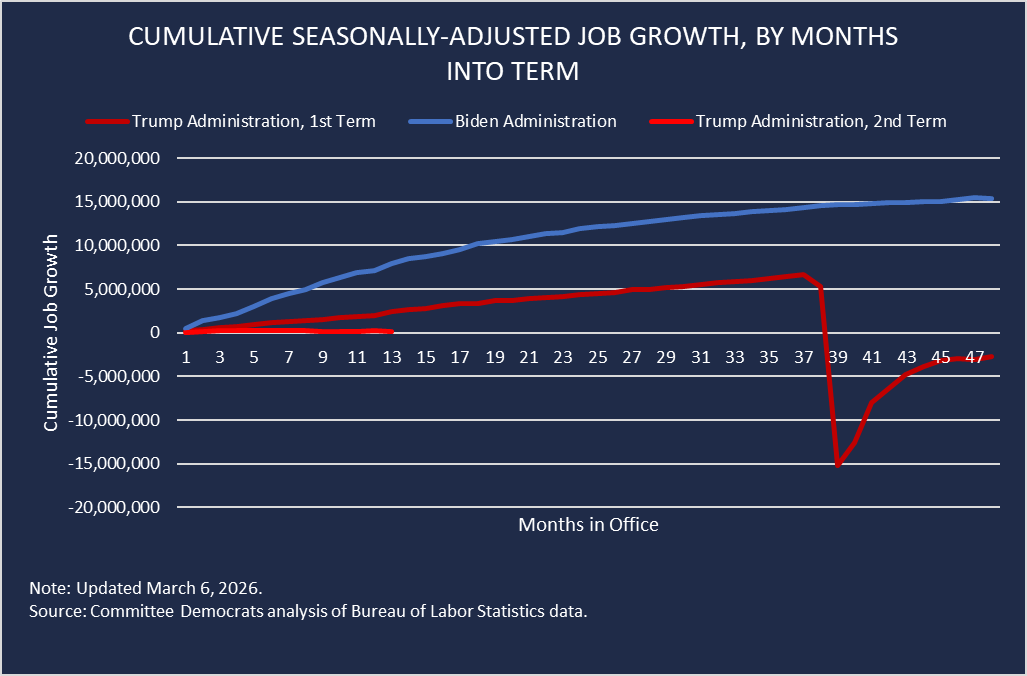
WASHINGTON – Ranking Member Robert C. “Bobby” Scott (VA-03), House Committee on Education and Workforce, released the following statement after theBureau of Labor Statisticsannounced that the economy lost 92,000 jobs in February, and the unemployment rate ticked up from 4.3 percent to 4.4 percent.
“Hardworking Americans are finding that a comfortable, affordable life is increasingly out of reach. The cost of health care, groceries, child care, student loans, and rent continues to rise, while workers are being left behind. According to a new report from Vanguard, a record number of Americans are raiding their 401(k) savings to cover their living expenses.
“While working families fight to stay afloat, the Trump Administration’s economic policies are funneling money into the pockets of the wealthy. The top 10 percent of Americans accounted for a record 49.2 percent of all spending in 2025, while the rest of America is being forced to cut back. Regrettably, the Trump Administration and Congressional Republicans have only deepened this divide by driving up health care costs to provide tax cuts for the wealthy in their ‘Big, Ugly Bill.’
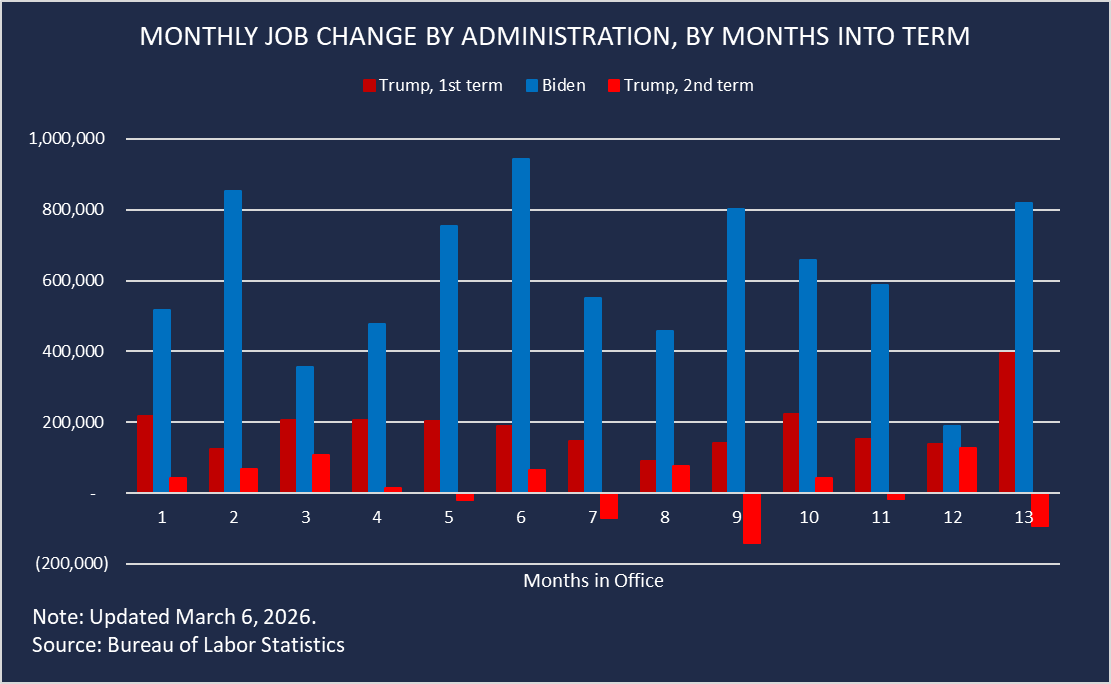
“The total number of jobs created in President Trump’s first year since returning to office was only 290,000 — a number the Biden Administration exceeded on average in a single month during his term in office. In fact, since President Trump returned to office, there has not been a single month in which the economy created as many jobs as President Biden’s average monthly job performance of 321,000 jobs.
“This is not the kind of economic performance working families were promised. During President Trump’s most recent State of the Union he repeatedly bragged about the strength of the economy. The truth is, this is the fifth month of job loss since President Trump returned to office.
“The American people deserve a government that prioritizes everyone— not just the wealthy few. Our economy is only strong when workers are strong. Democrats will continue to fight for policies that put working people first, create good jobs, and lower everyday costs for all Americans.”
To see a chart comparing the cumulative seasonally adjusted job change by month between President Trump’s first and second terms, and President Biden’s presidency,click here.
To see a chart comparing the total job change between President Trump’s first 13 months in office and President Biden’s first 13 months in office,click here.
Source: United States House of Representatives – Congresswoman Lori Trahan (D-MA-03)
LOWELL, MA – Today, Congresswoman Lori Trahan (MA-03) demanded the immediate release of a 14-year-old Marlborough resident who was detained yesterday by U.S. Department of Homeland Security agents:
“Yesterday, a 14-year-old girl from Marlborough was detained by federal immigration agents. A child with no criminal history was taken into custody in an apparent overnight attempt to use her as a hostage to coerce her father into turning himself in for deportation. As a mother to 15- and 11-year old daughters, I am furious. This is not immigration enforcement. It’s the deliberate targeting of a child to inflict maximum pain on her family.”
“Two months ago, ICE detained five-year-old Liam Ramos in Minnesota under similar circumstances. The nation watched in horror as a little boy with a blue bunny hat and Spiderman backpack was taken into custody by federal immigration authorities. The ordeal was so heinous that a federal judge ordered his release and called it ‘cruel’ and ‘bereft of human decency.’ But now, federal immigration agents seem to be doing it again, this time here in Massachusetts.”
“I am demanding her immediate release. She should be returned home to her family this afternoon and able to go back to school tomorrow. In the meantime, DHS must abandon its clearly adopted policy of using children as bait to detain and deport family members and instead focus its efforts on violent criminals.”